INFO642 CONTENT STRATEGY

Content Strategy for NPR’s On the Media: Enhancing Discovery and Clarity

Overview

This project was part of a semester-long content strategy course focused on On The Media (OTM), a weekly public radio show and podcast produced by WNYC. Because OTM sits within a larger ecosystem (WNYC, NPR, and member stations like WBUR), we also analyzed NPR.org and WBUR.org to understand the broader editorial and distribution environment.

My Role

I was one of eleven content strategists and UX designers.

Discipline

Content Strategy

Platform

Website & Mobile

Time Frame

12 Weeks

Project Goal

This project aimed to evaluate and enhance On The Media’s digital content strategy. The goal was to provide clear, actionable guidance on how to improve content structure and formatting to better support audience engagement and long-term digital growth.

Make On The Media's online presence clearer and more cohesive that support its mission, brand, and vision

Improve discoverability and engagement for younger and more casual audiences

Prepare On The Media for a future where video and short-form content are central entry points

Methods

We used a range of research and content strategy methods to understand how OTM’s digital experience works and where it can be improved.

Audience & Market Understanding

Created personas to represent different types of OTM listeners and used them to understand what each group expects from OTM’s website and digital presence.

Mapped user journeys to visualize how each persona discovers, navigates, and engages with OTM’s content across platforms.

Analyzed competitor sites to identify formatting patterns, content structures, and ideas OTM could learn from or differentiate with.

Reviewed OTM’s existing content to spot what’s working, where things feel inconsistent, and where structure or clarity could be improved.

Content Structure

Defined content classes to clarify the different types of content OTM produces and how each should be formatted on the site.

Analyzed content channels to understand how the website, podcast apps, and social platforms each support user needs.

Developed a metadata and content model to map how episodes, segments, and topics connect, improving organization and discoverability.

Studied OTM’s tone of voice to outline consistent editorial guidelines for messaging across digital platforms.

Experience, Interface & Formats

Conducted a mobile content analysis to see how layout, hierarchy, and readability impact the on-the-go user experience.

Explored voice-based content interactions to understand how users might request OTM content through voice assistants.

Ran a content usability analysis to uncover navigation issues and points where users struggle to find or understand information.

Preliminary Findings

Key Themes: What On The Media’s Digital Presence Reveals
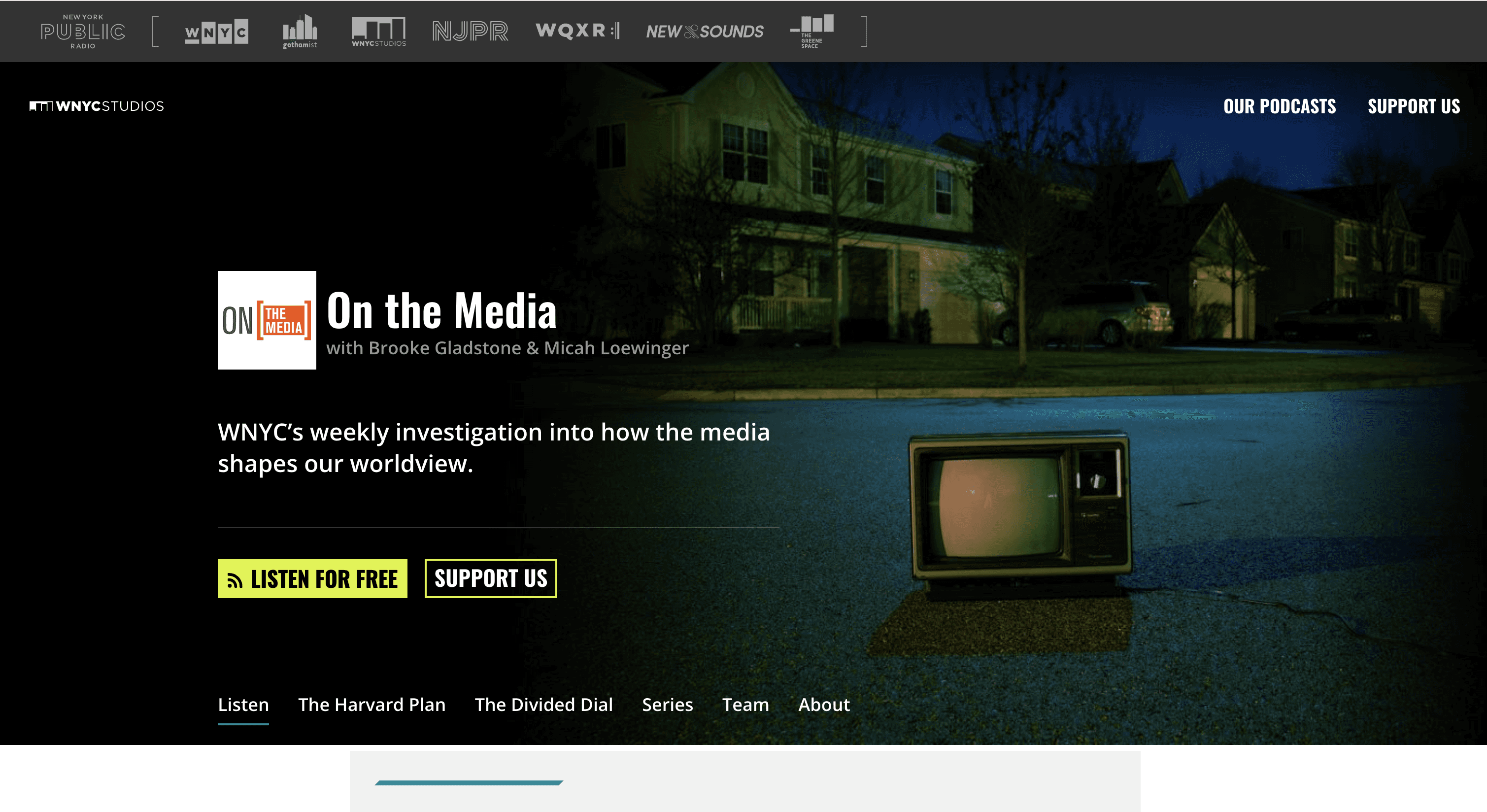
Strong Editorial Identity — Serious, Investigative, and Context-Driven

On The Media presents itself as a deeply investigative journalism brand. The tone is serious, analytical, and grounded in long-form reporting. Their digital presence reflects this: long headlines, dense summaries, and a strong emphasis on context over quick takes.

Storytelling Focused on Media, Power, and Explanation

OTM isn’t just reporting events — it explains systems. Their stories focus on why things happen, what structures are behind the news, and how media shapes public understanding. This “meta-journalism” angle comes across clearly in both their content topics and how episodes are described.

Heavy Reliance on Text and Long Summaries

Episode pages tend to feel dense, with long descriptions and transcripts emphasized. The digital experience leans toward reading rather than skimming, which reinforces the brand’s seriousnes

On The Media has a strong editorial identity and rich journalistic depth, but its digital experience is heavily optimized for loyal listeners rather than discovery, quick understanding, or cross-platform engagement.

Main Takeaway

User Persona

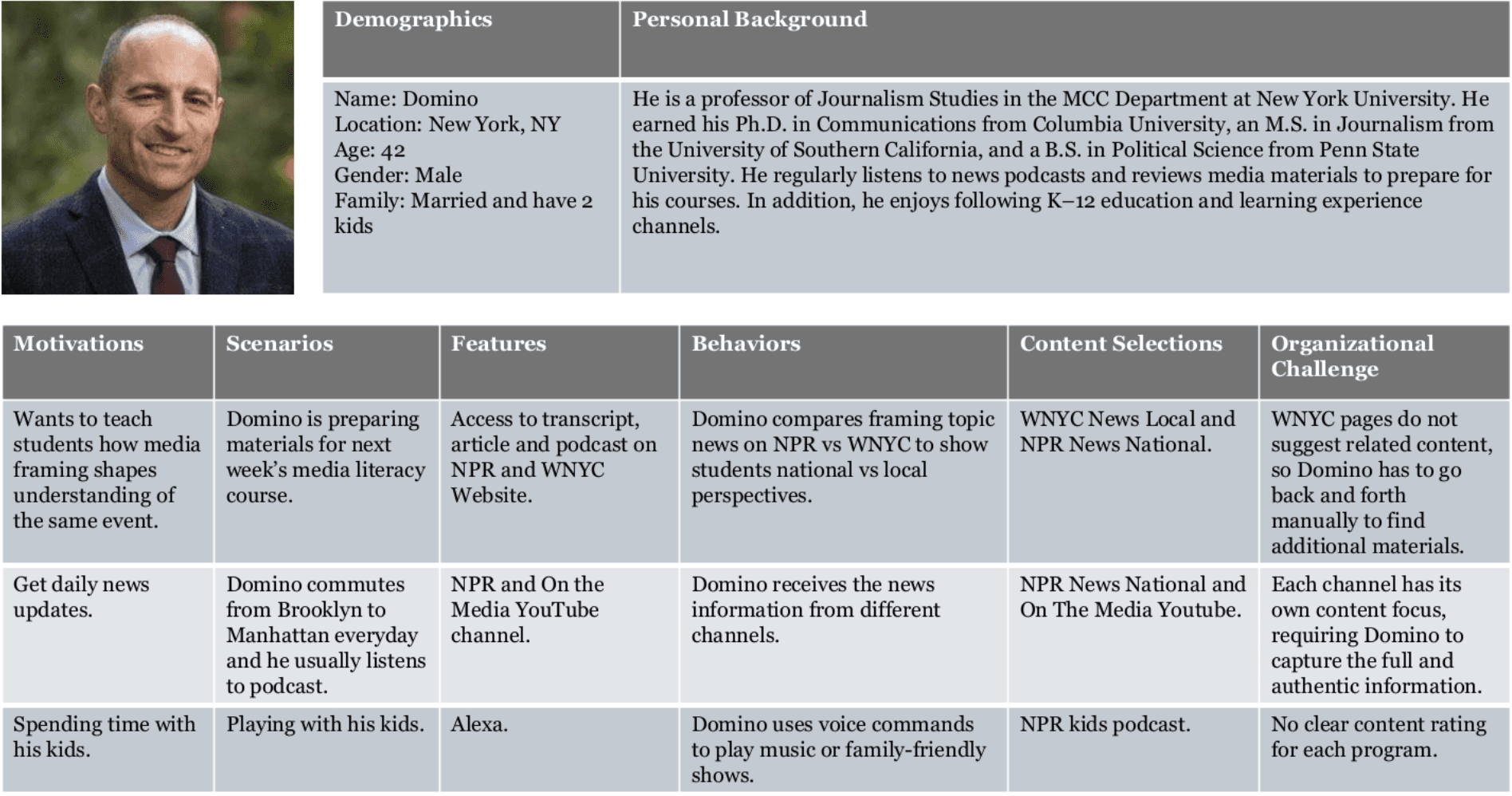
To understand who On The Media’s digital experience is really serving, we looked beyond a single listener type and explored how different audiences interact with OTM, NPR, and member-station platforms like WBUR
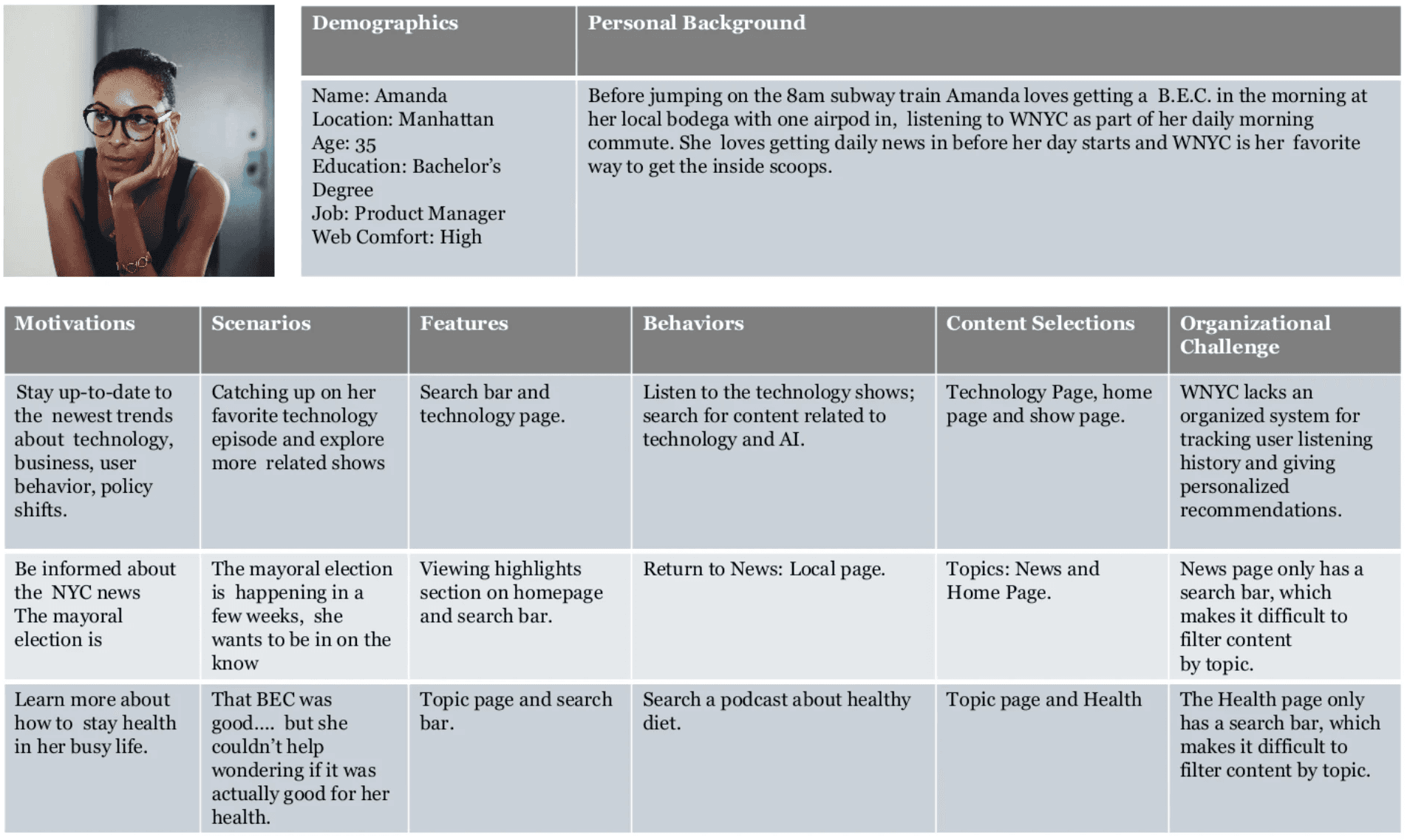
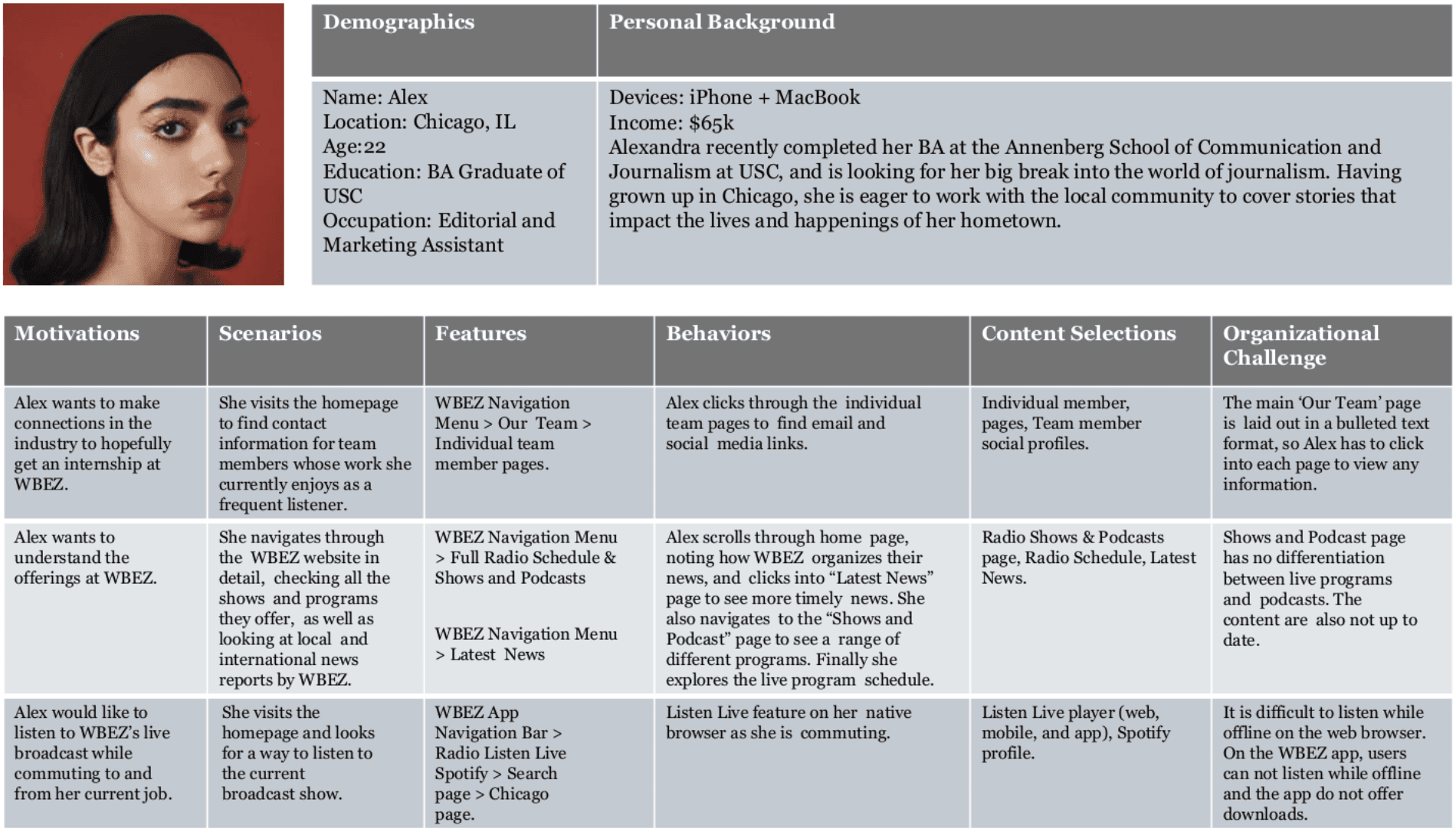
Although these four personas range from casual listeners to media professionals, they share a common set of expectations:

  • Reliable navigation across platforms

  • Clear content structure

  • Easy discovery of related episodes or themes

  • Formats that support both quick skimming and deep engagement

Journey Map

We used a customer-journey framework to understand how listeners move from first discovering On the Media to becoming engaged, loyal supporters.

What we found:

Across all four personas, users follow the same general journey: they discover OTM through NPR or platform algorithms, evaluate whether episodes match their needs, build listening habits through recurring engagement, and eventually subscribe or share content.

This helped us identify key moments where clearer structure, better formatting, and improved content pathways could meaningfully strengthen their experience.

Identification

Awareness/Exposure

Consideration/Evaluation

Selection(Trial)

Engagement

Subscription

Relationship Building

Competitor Analysis

We evaluated key competitors to understand how leading news and audio brands structure their content, guide user journeys, and build loyalty across platforms.
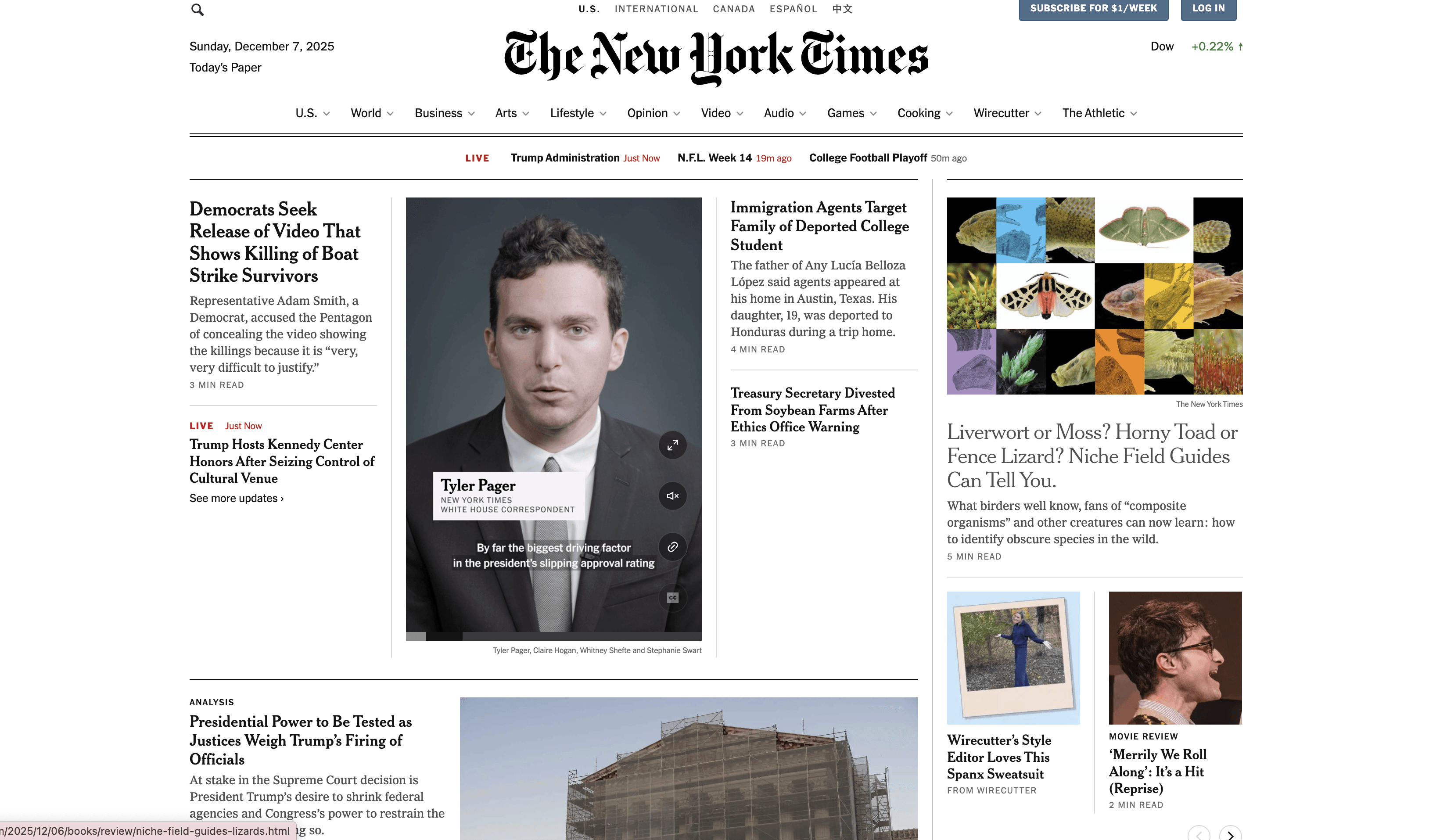
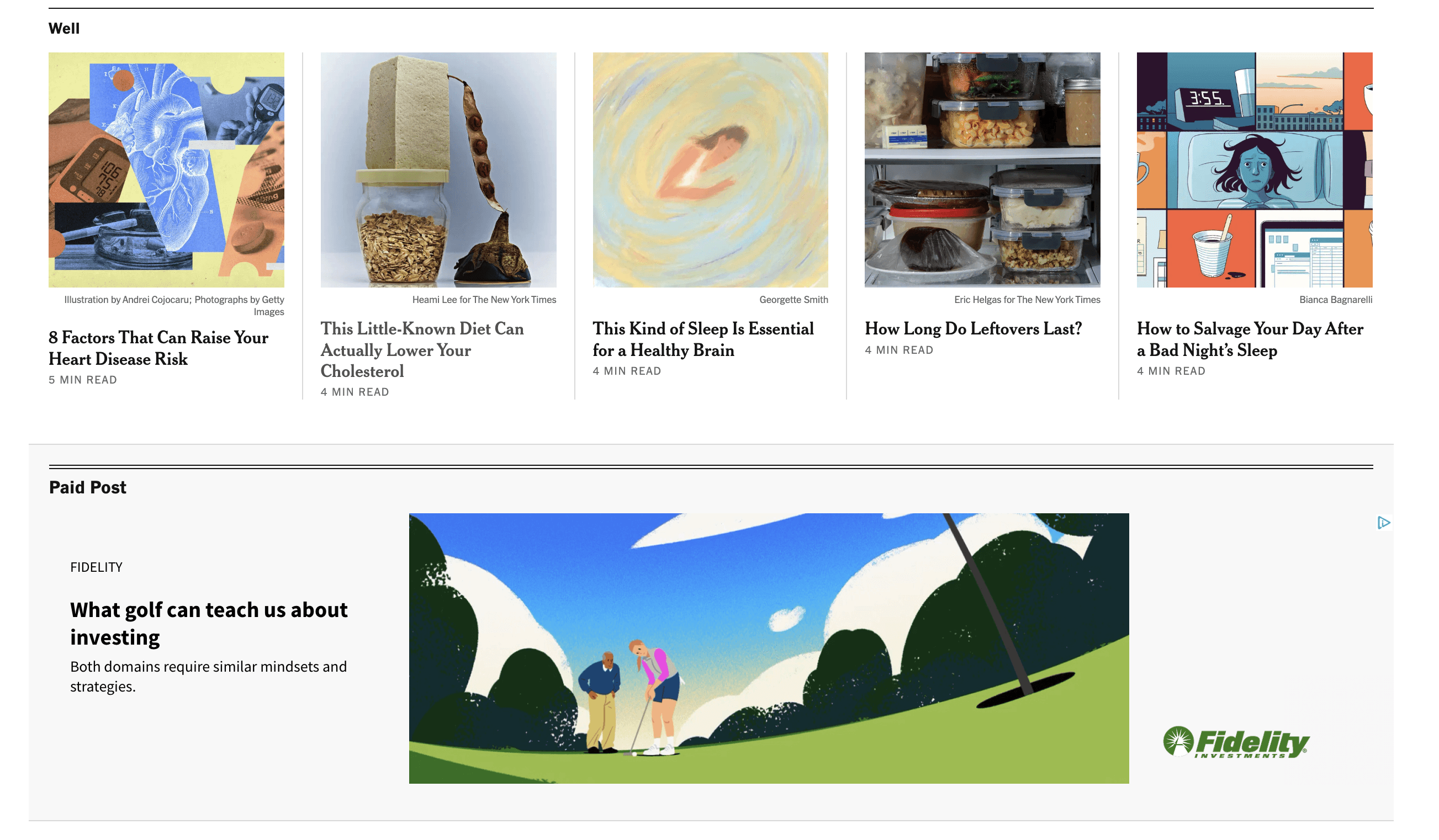
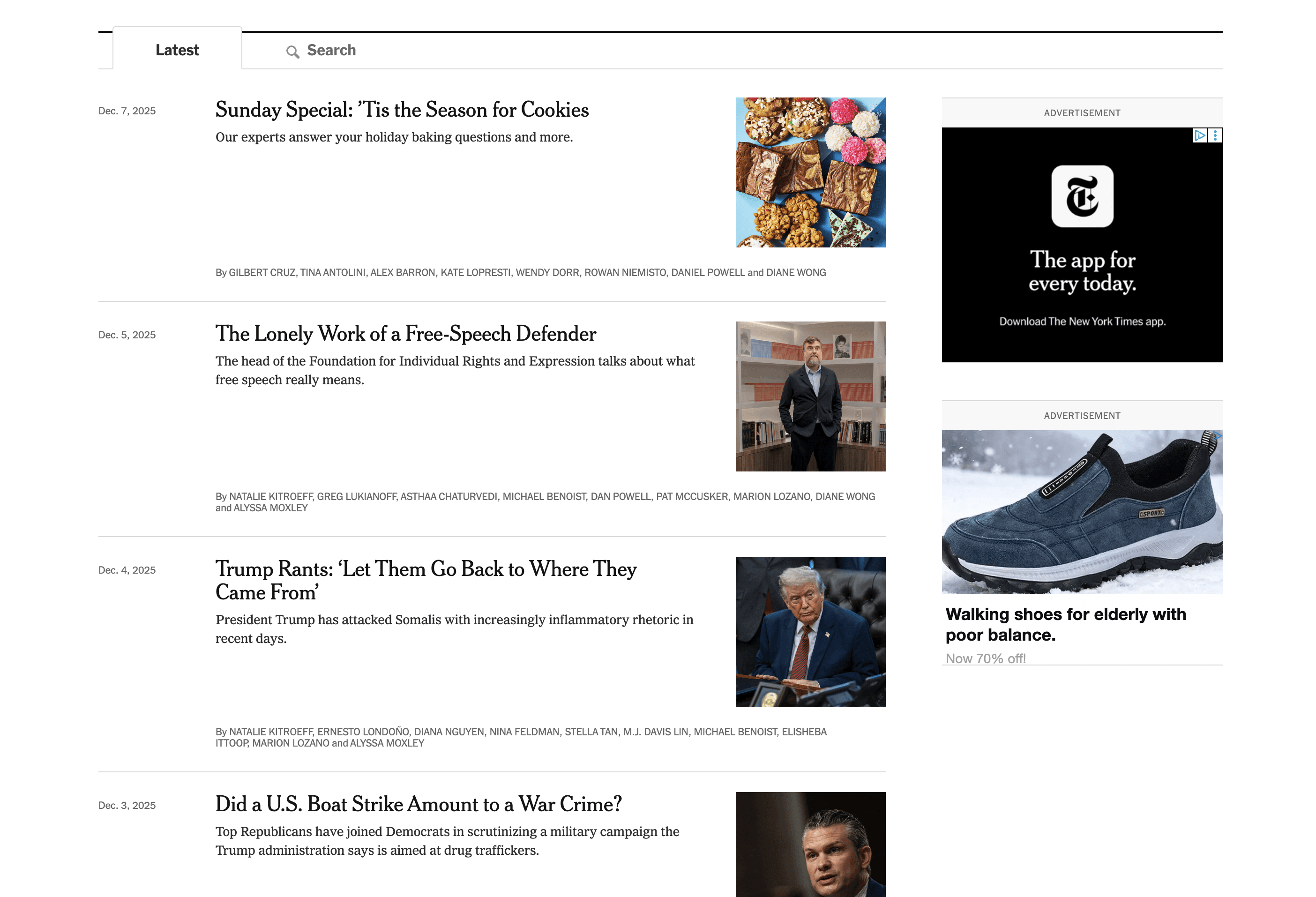
The New York Times stands out for its strong visual identity and authoritative news voice, but its heavy emphasis on legacy formats can create a dense and overwhelming experience for casual users.

  • Strong legacy print look drives authority but can feel dense.

  • Homepage centers politics and public affairs, with lifestyle as secondary.

  • Wide vertical ecosystem (Games, Cooking, Wirecutter) keeps users circulating.

  • Audio is harder to discover, overshadowed by text-first navigation.

NY Times

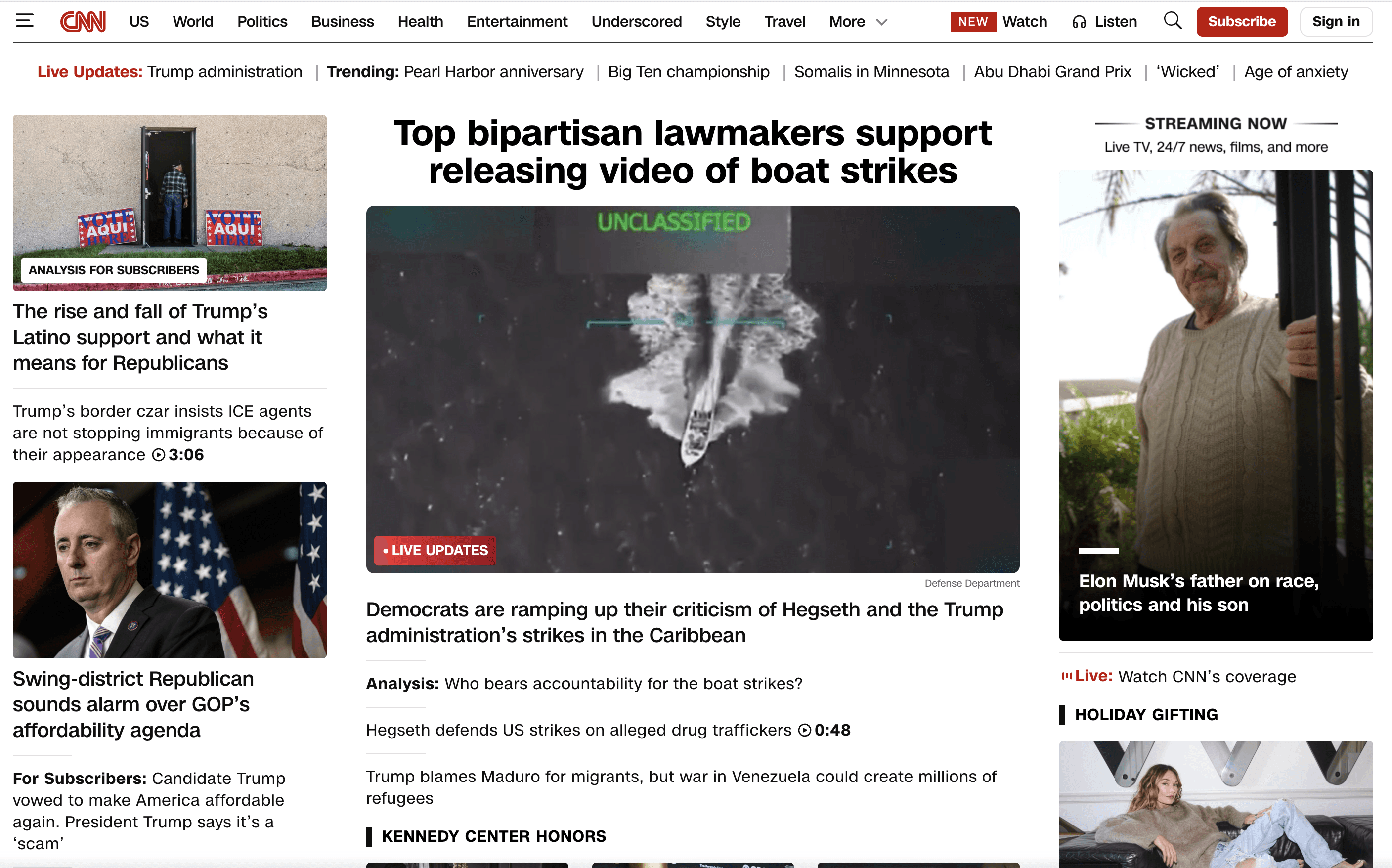
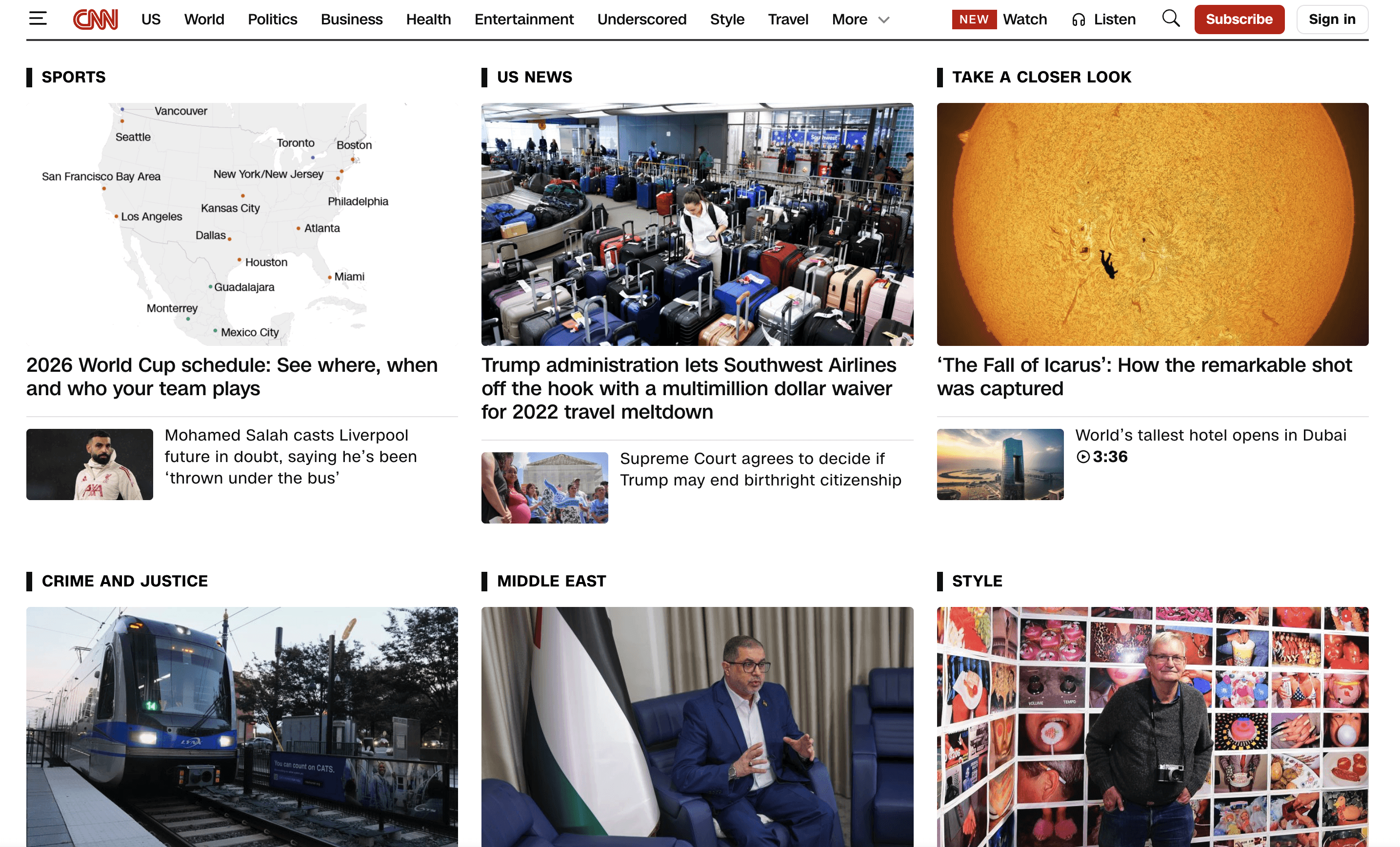
CNN’s site delivers everything at once through a fast-moving, visually dense news feed, but the sheer amount of content and inconsistent structure can make the experience feel overwhelming.

  • Highly visual, “all the news right now” layout keeps users updated quickly but can feel chaotic.

  • Navigation is extremely broad, offering every topic and sub-topic at once.

  • Strong video + live content integration reinforces CNN’s identity as a real-time broadcaster.

  • Information hierarchy is inconsistent, making it harder for users to understand what’s most important at a glance.

CNN

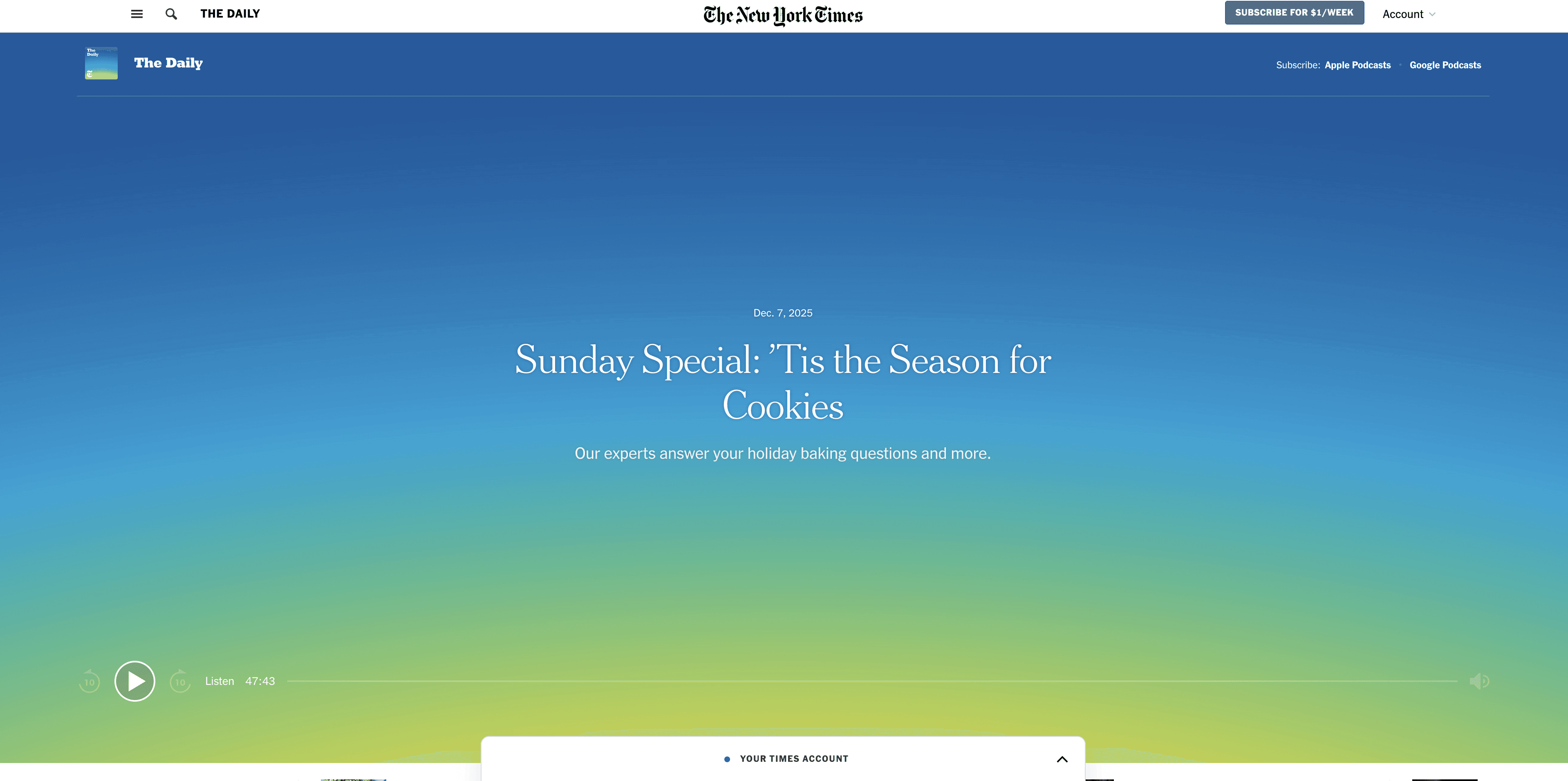
The Daily is a best-in-class digital-first audio product with clear structure and strong conversion power, but its presentation still leans heavily on traditional vertical news layouts.

  • Well organized episode cards and hierarchy make scanning effortless.

  • Podcast-first storytelling gives the product a distinct identity compared to repurposed radio.

  • Strong funnel into NYT’s ecosystem, using talent-driven journalism and cross-links.

  • Transcripts and multi-format access improve accessibility and SEO.

NYT The Daily

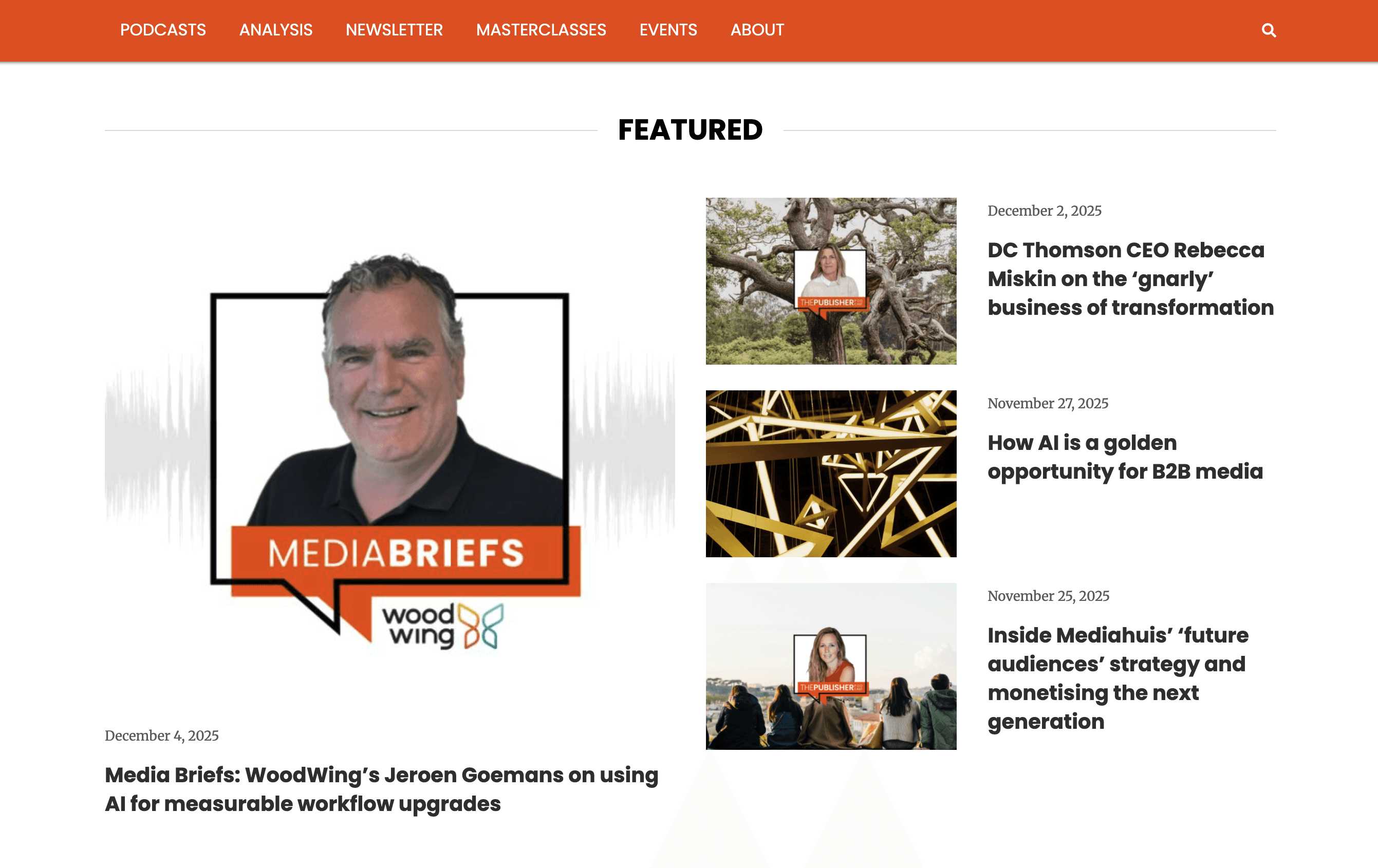
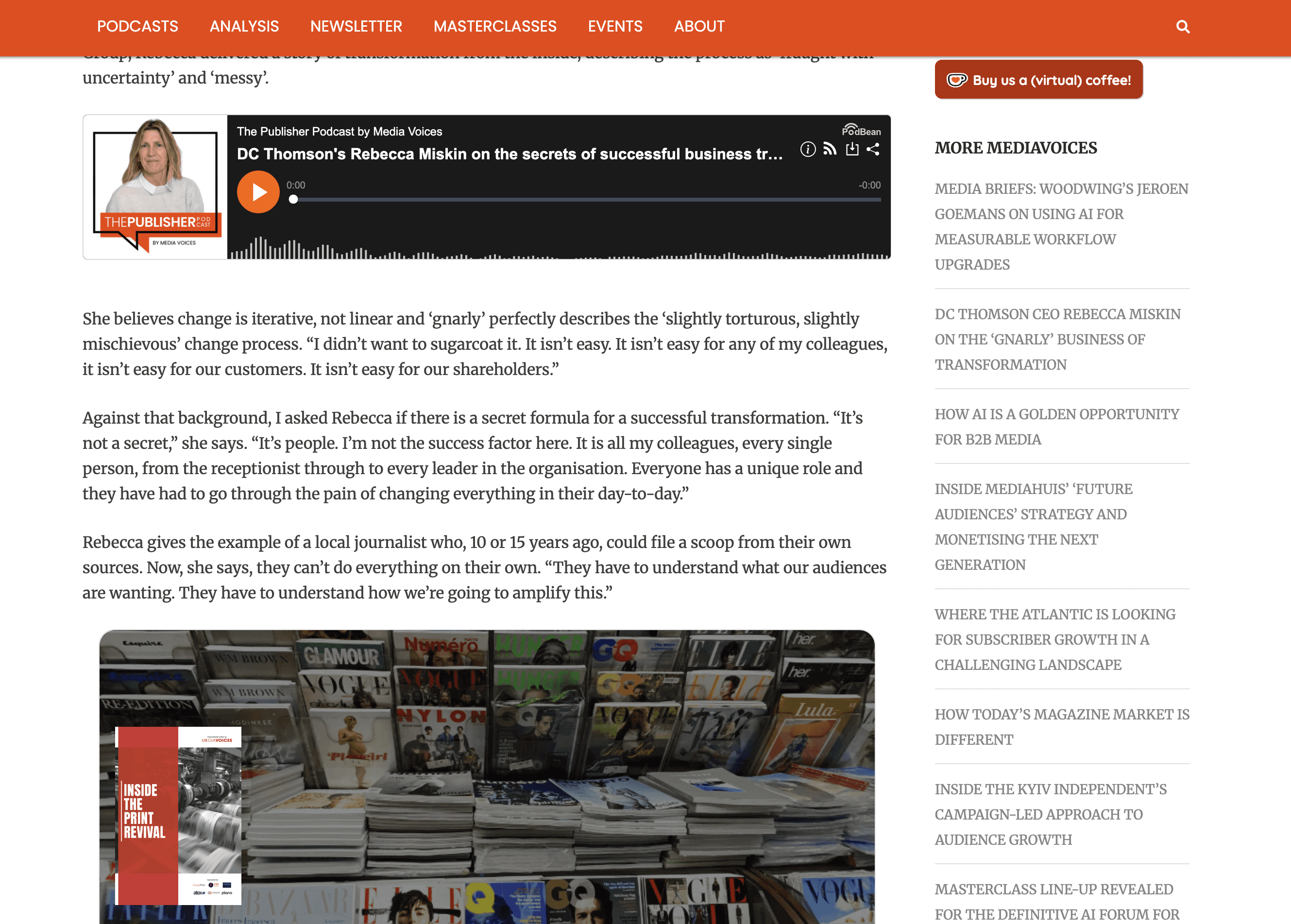
Media Voices presents itself as a professional, industry-facing hub with a polished magazine feel, but its content hierarchy often blurs distinctions between formats and makes navigation less intuitive.

  • Strong focus on media/publishing trends geared toward professionals.

  • Consistent speaker imagery creates a human, community feel.

  • Podcast and article layouts look similar, making content types hard to tell apart.

  • Home experience is rich but feels fragmented without clear paths.

Media Voices

The landscape shows a clear pattern: users get overwhelmed when everything is treated as equally important. A cleaner hierarchy and an audio-centric layout give On the Media a competitive advantage in guiding listeners from casual browsing to deeper engagement.

Main Takeaway

Content usability

We evaluated how users understand and engage with OTM’s content by gathering insights from 22+ participants.

Questions

  1. Are you familiar with “On the Media”? If so, how?

  2. Did this content piece contribute to / enhance your understanding of “On the Media,” their mission and goals?

  3. Was this content piece easy to understand?

  4. Was this content piece structured in a way that made it easy to read/consume?

  5. Would you share this content with someone, either via email or a social media channel? Why (or why not)

  6. Did this content piece encourage you to explore other pieces of content on the site? If so, how and why?
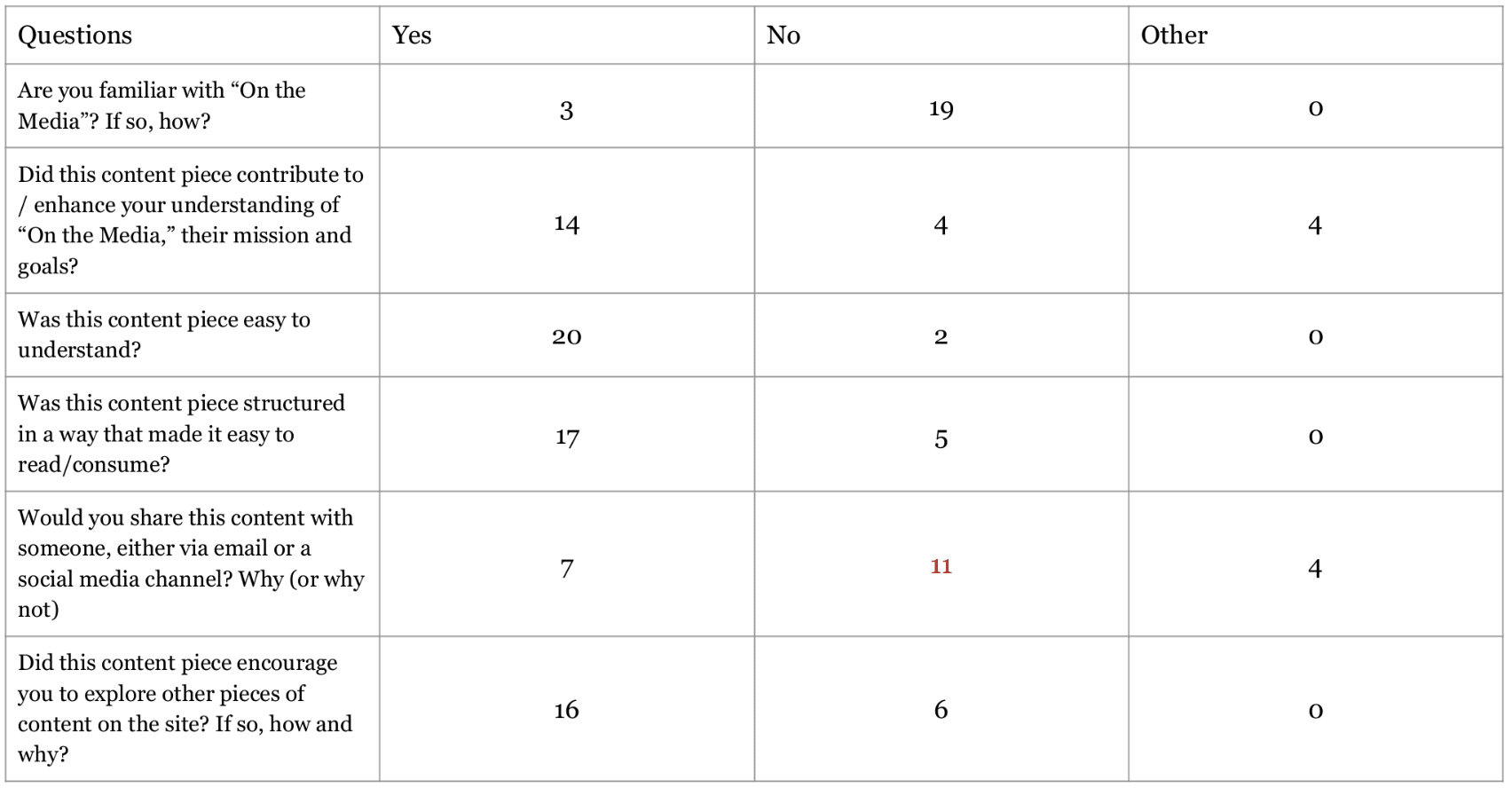
Results we got from 22 participants

Finding 1

Most participants were unfamiliar with On the Media and what content

it produces.

“This is my first time hearing the On the Media.”

“I’ve come across On the Media through podcast apps but didn’t listen to any of them before.”

“I definitely followed them on Spotify but I only listen if it showed up on my Home page. Just on and off listening.”

Finding 2

Participants felt that OTM explains the “why” behind the news with a

direct and critical tone.

“The tone felt more direct and I enjoyed that. I didn’t know much about OTM’s mission and goals, but I felt it was well-researched, and I also appreciated having an expert on the podcast rather than it being just a conversation between ‘two random people’ .”

“The show doesn’t just cover news, but digs into how media and technology shape our world, which aligns with what I expected of their mission.”

Finding 3

Participants explored more content only when the topic interested them,

not because of the show itself.

“I might explore other episodes they’ve released to see if there’s something that matches my interests.”

“The participant said the strong reporting made them somewhat interested in what else the show covers, but only if the topic matched their interests.”

Recommendations

With these insights in mind, we move into our recommendations for On the Media.
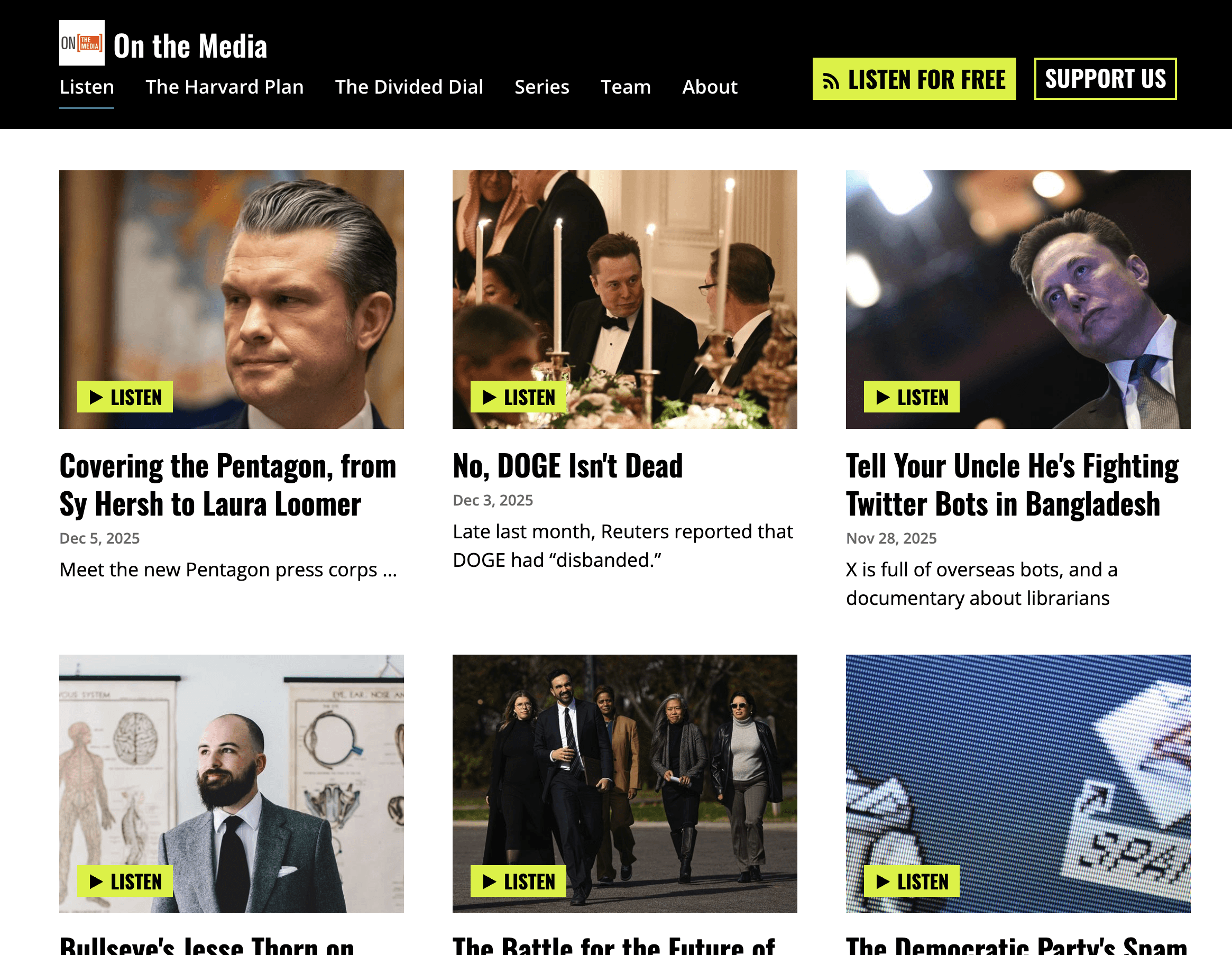
User research showed most participants were unfamiliar with OTM. Adding highlight sections, popular episodes, or curated topic hubs can help newcomers understand what the show is about without feeling overwhelmed.

Build clearer “on-ramps” for new or unfamiliar listeners.

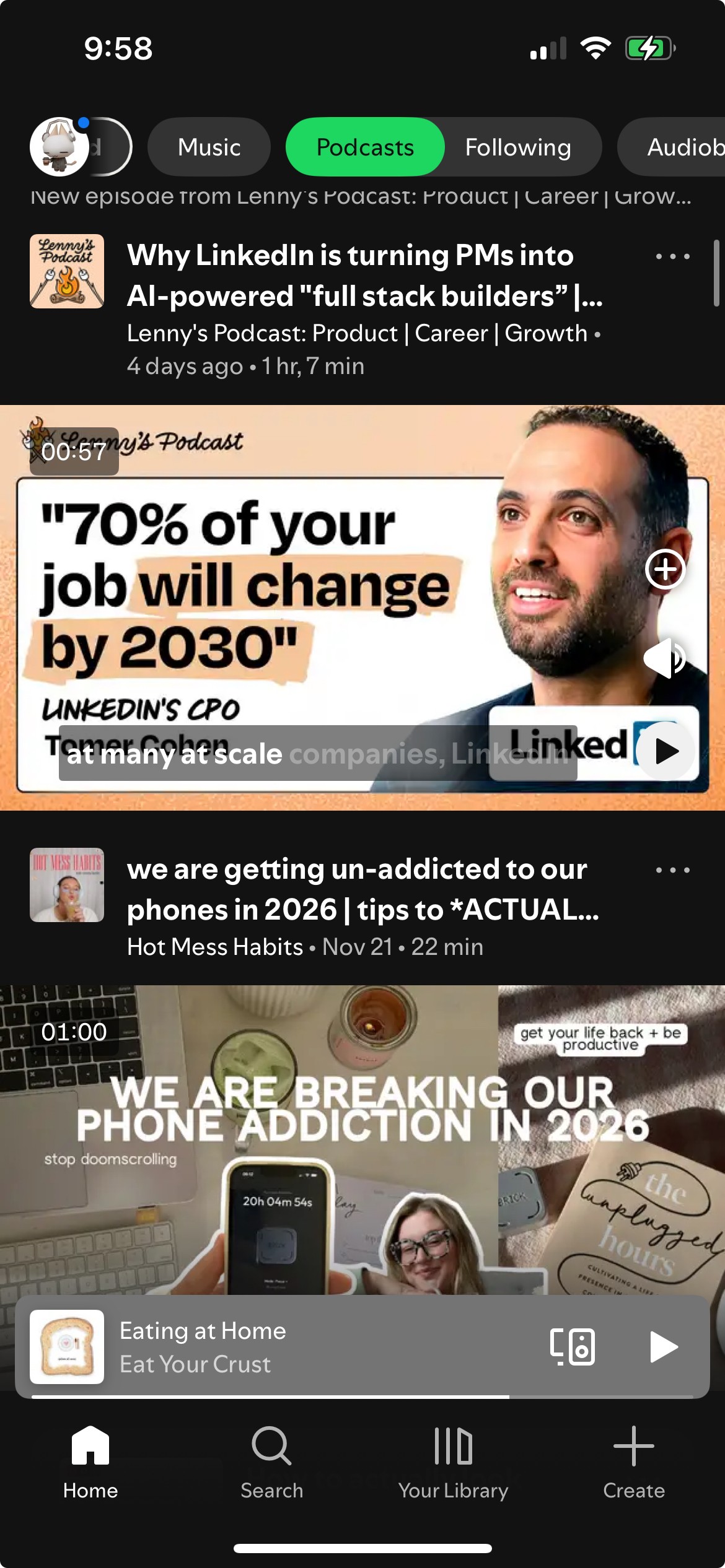
Adding a short featured clip section on the On the Media homepage could quickly convey the show’s tone — similar to how Spotify showcases content.

Strengthen cross-platform discovery with reusable, evergreen content.

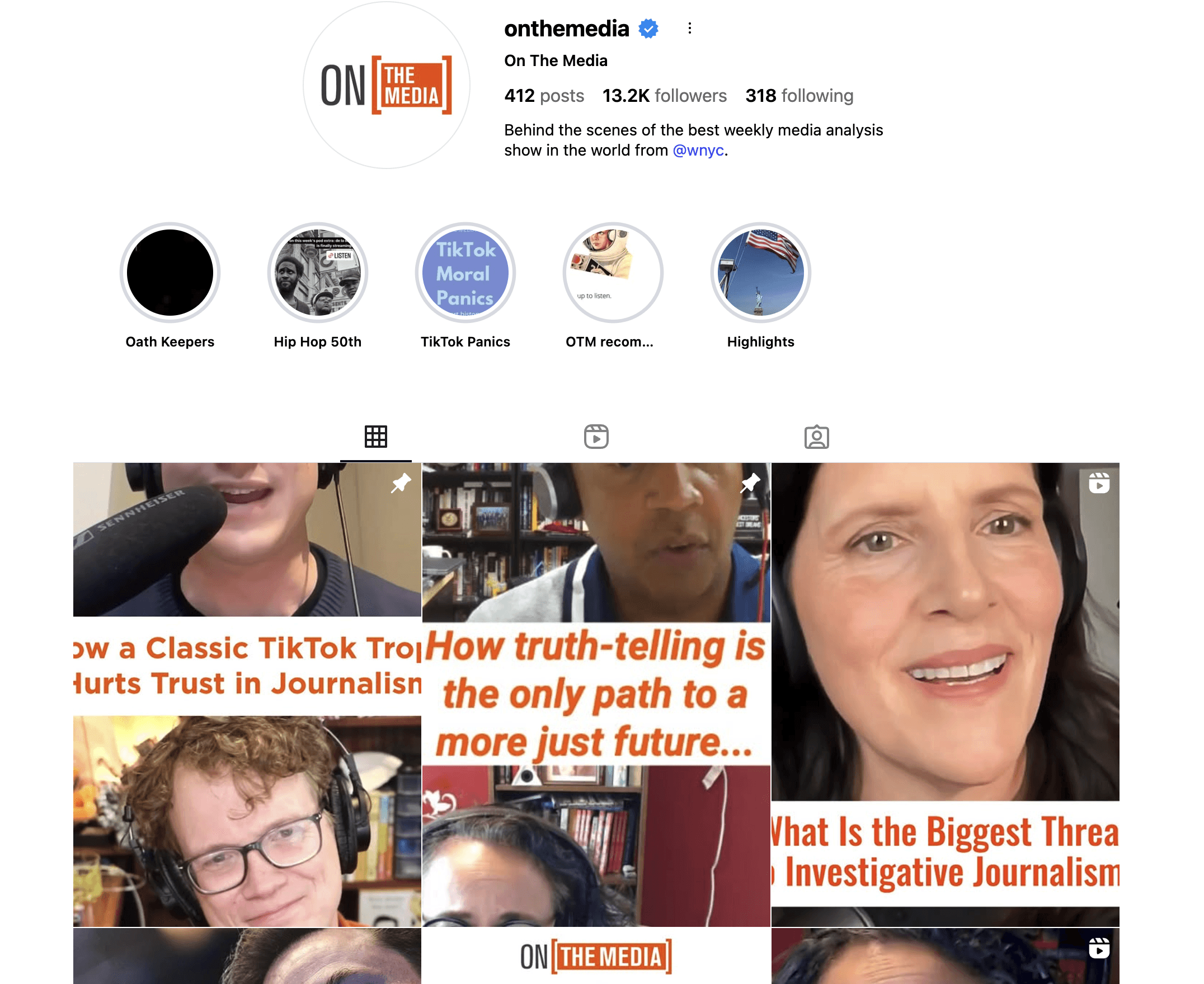
Many listeners discover OTM by accident and rarely explore further. NPR should package episodes into short, visually branded clips optimized for each platform (TikTok, Reels, YouTube Shorts) to create repeat, lightweight discovery moments.

Creating a consistent visual system for clips — including branded covers, recurring typography, and color styles — would make OTM’s content more discoverable across TikTok, Reels, and YouTube Shorts.

A newsletter offering mini-essays, book notes, and recommended episodes can deepen loyalty while reinforcing OTM as a thought leader in media criticism.

Strengthen cross-promotion and content extensions.

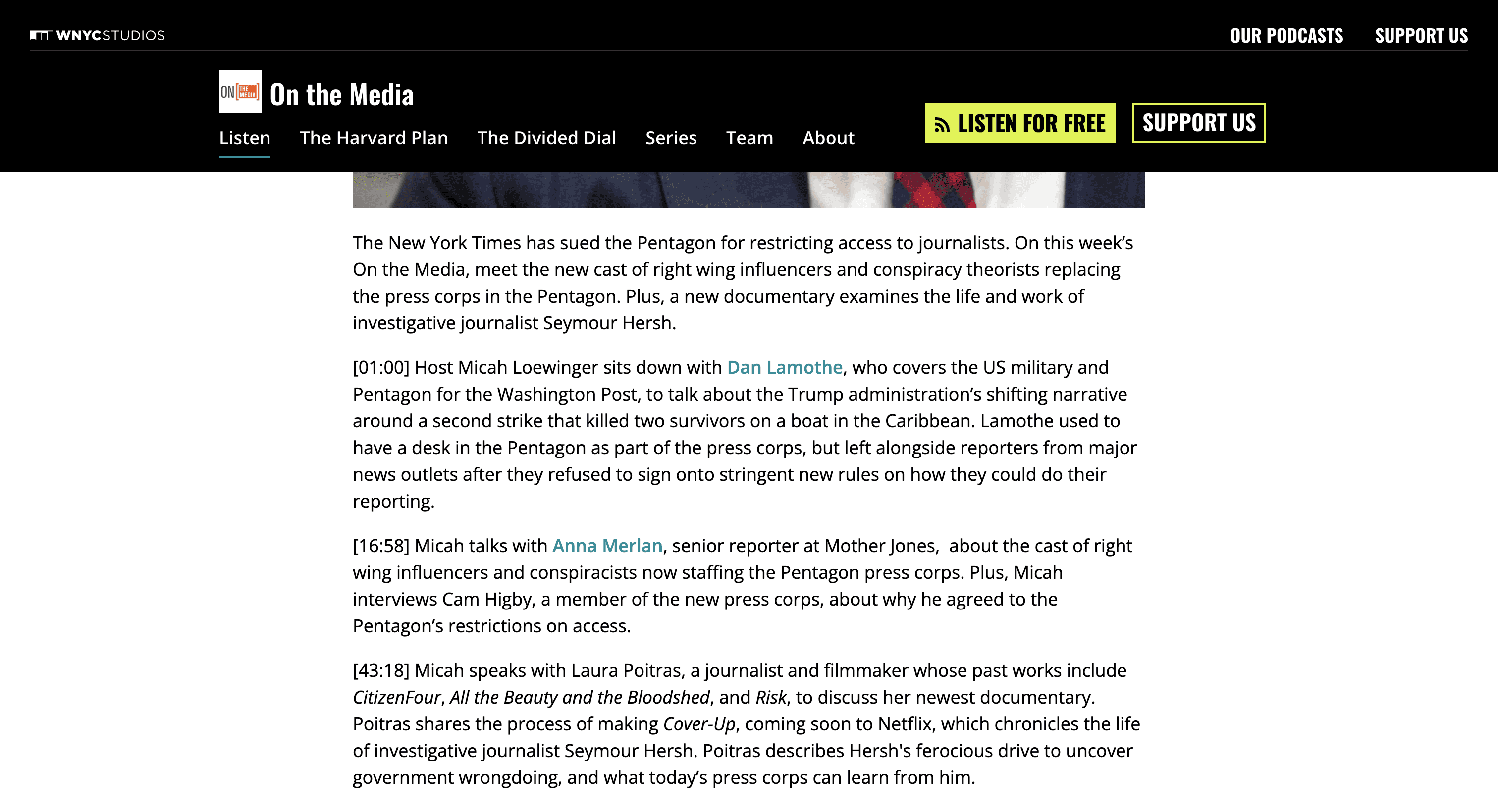
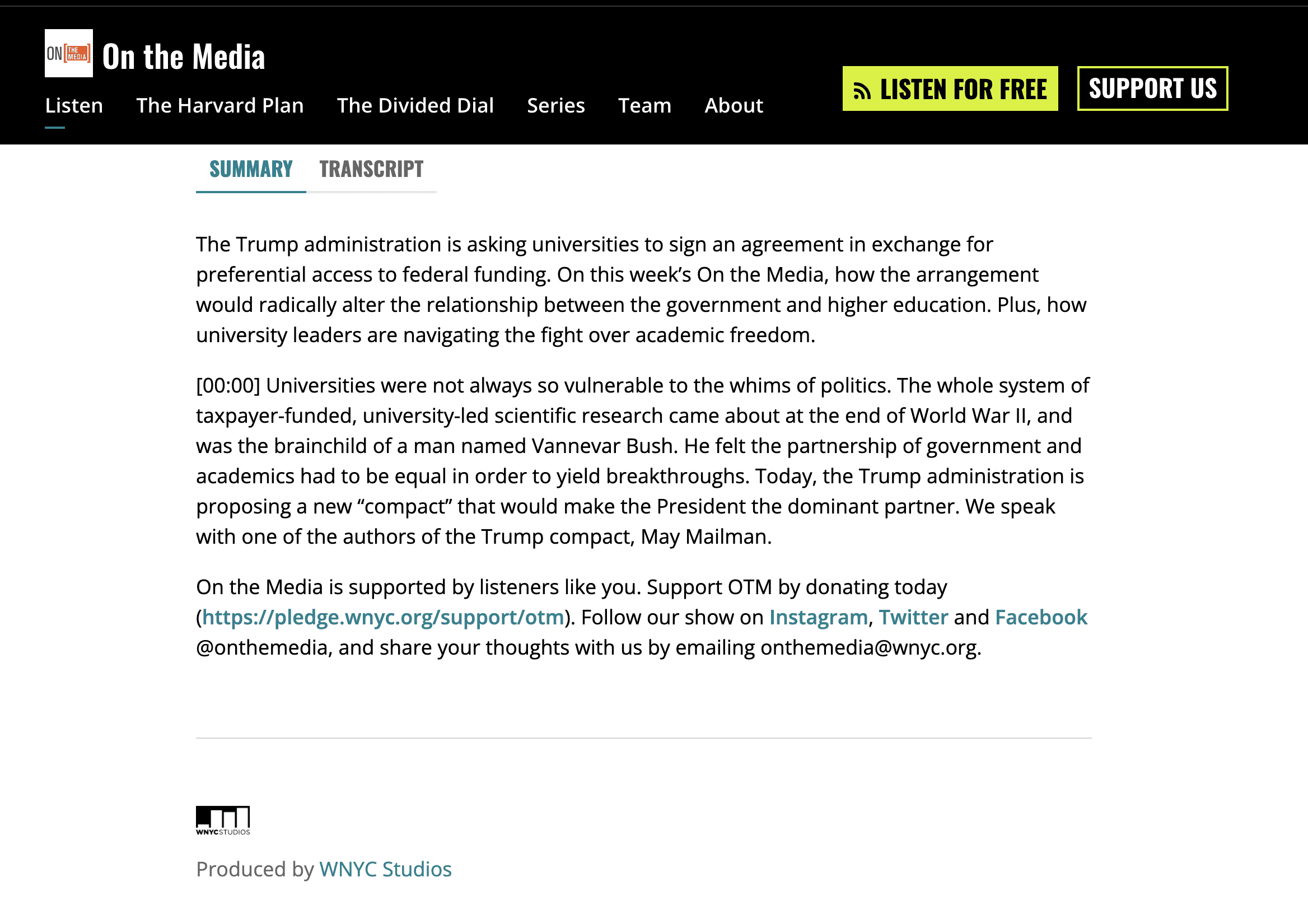
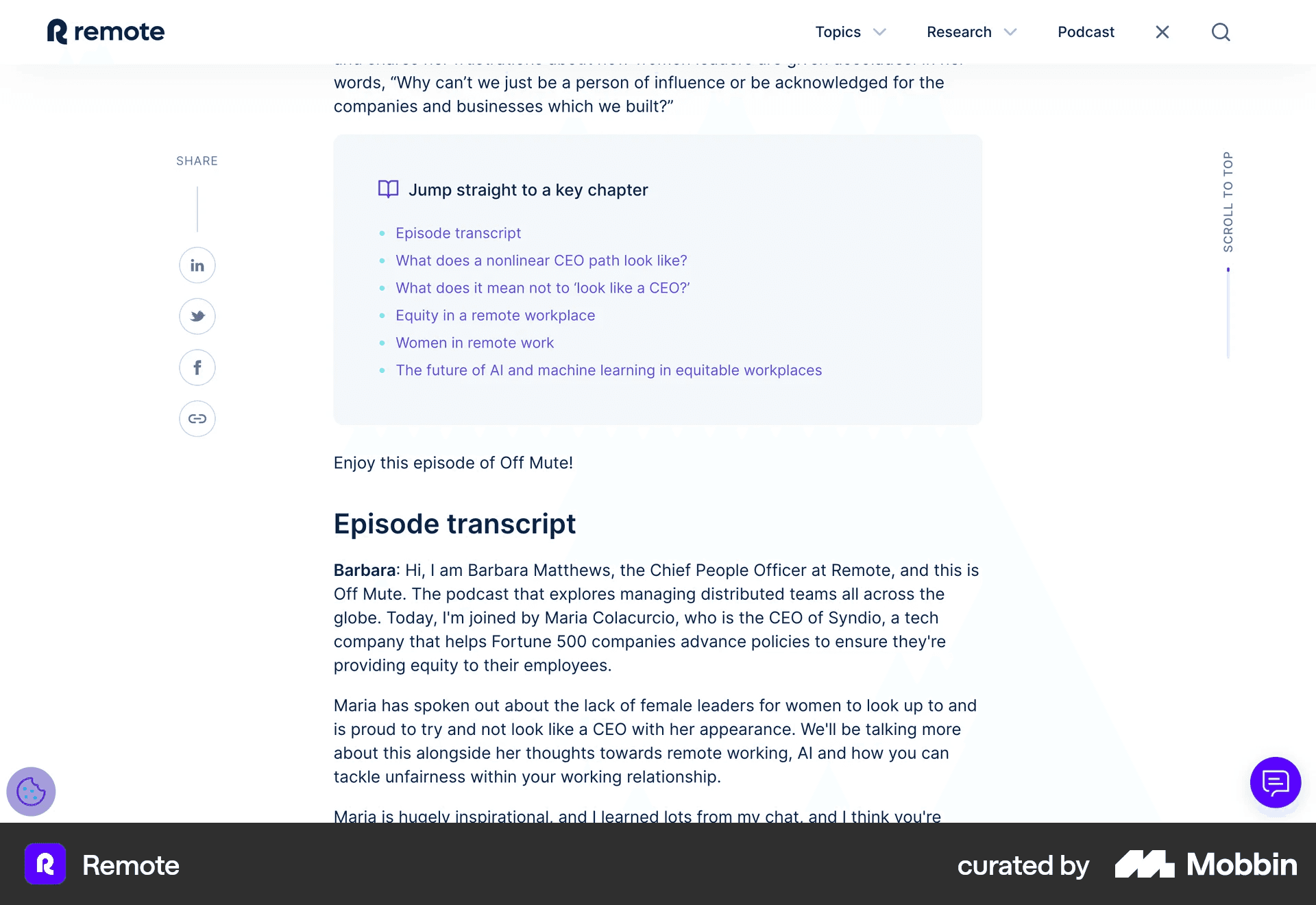
Under each episode's summary and transcript—especially the more complex ones—OTM could offer a clearer, more structured summary. Adding sections such as

• “What we discussed”

• “Why it matters”

• “Related stories you may have missed”

would give listeners stronger context and help them discover additional relevant episodes.

This is a great example of how to provide structured links and supporting content under a complex episode.

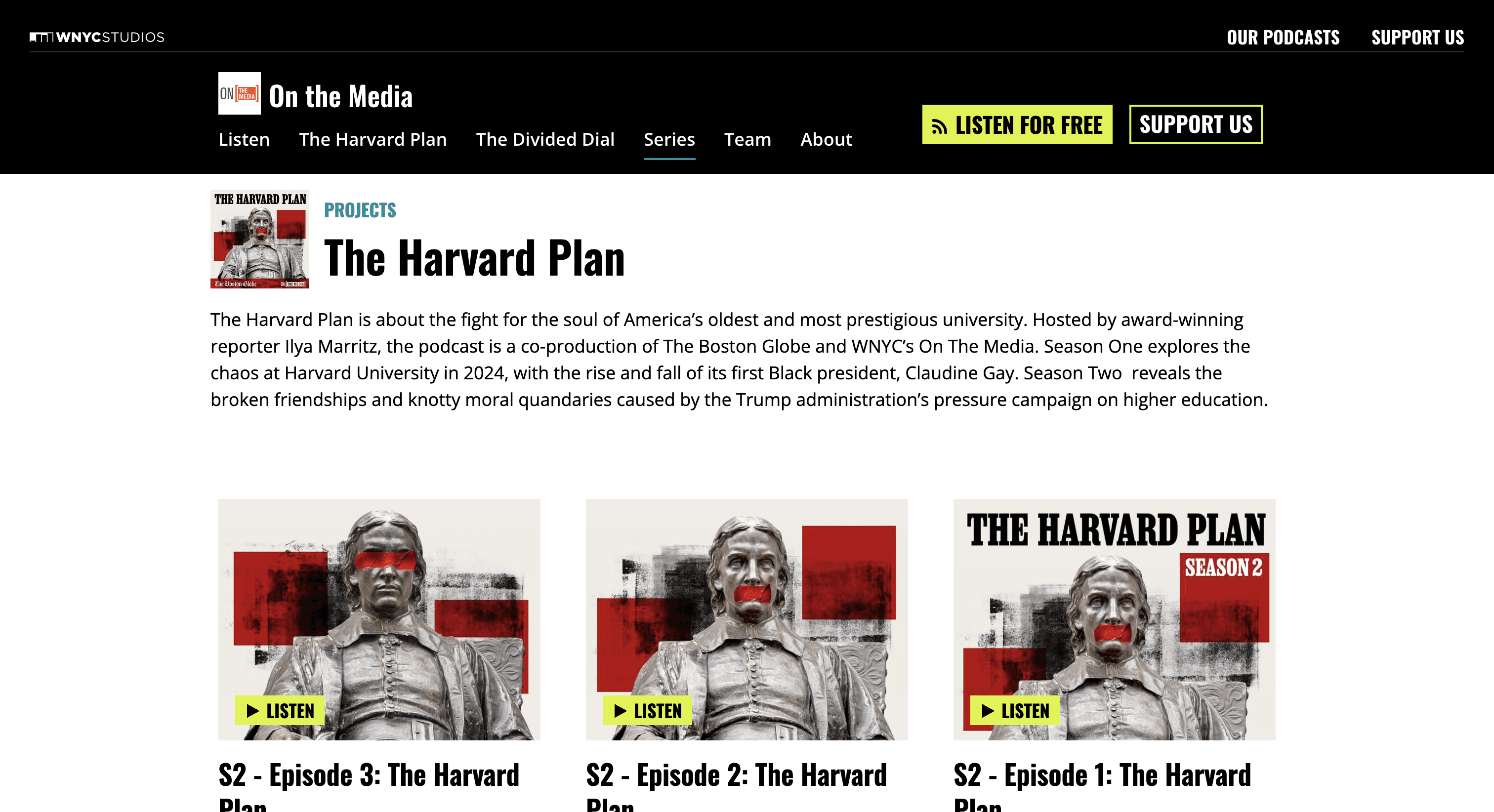
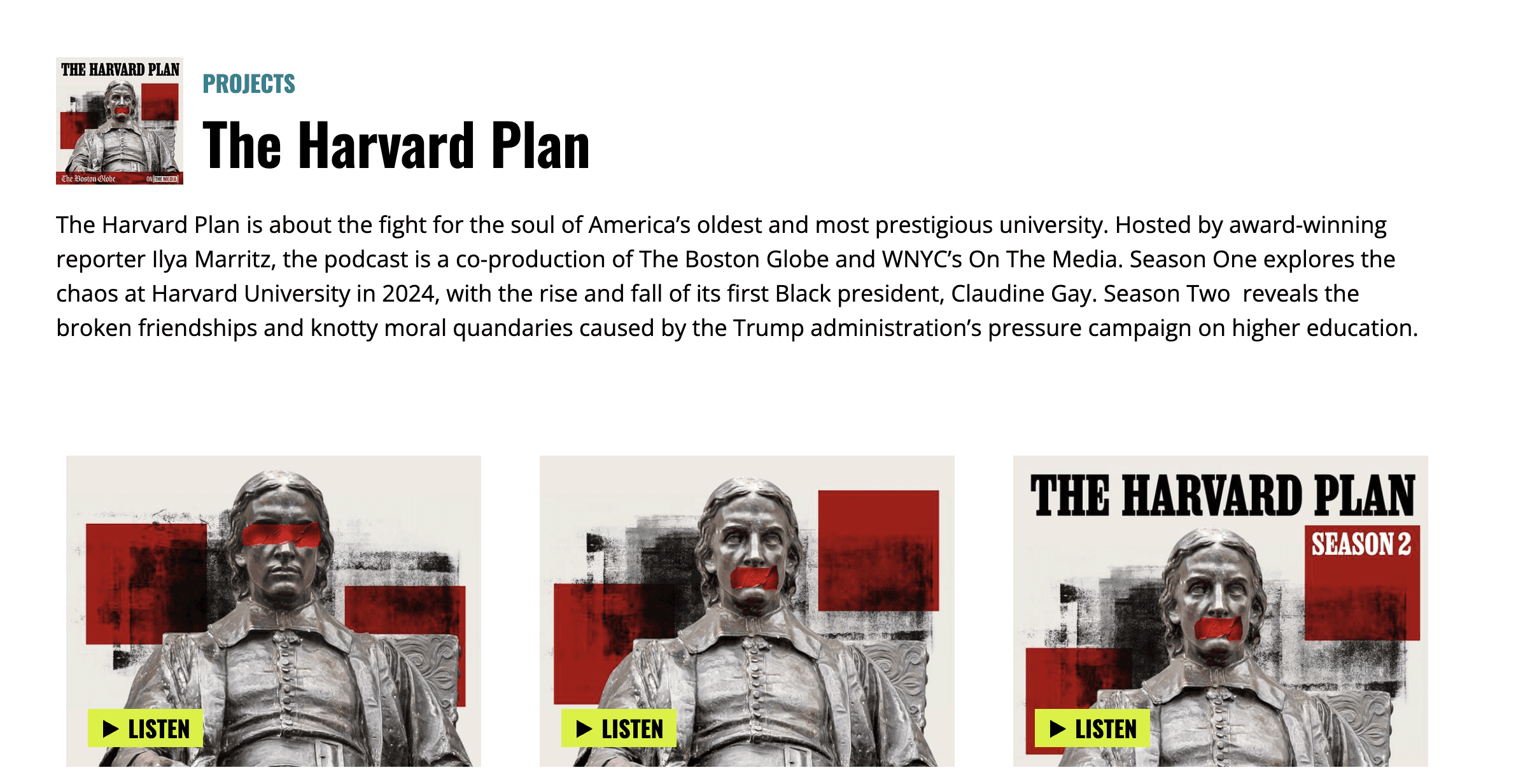
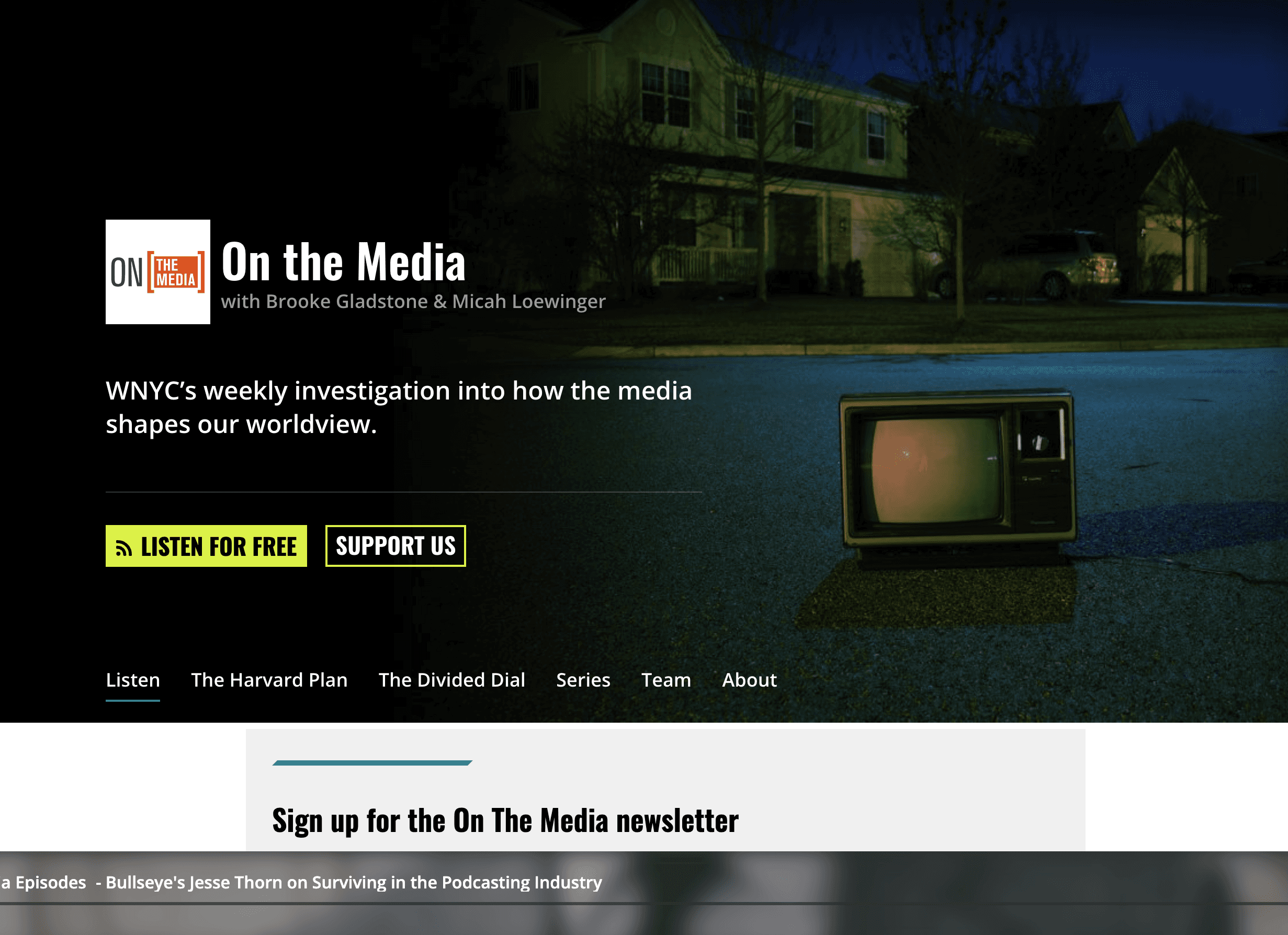
Adding a brief series summary here would help users quickly understand what the project is about and clarify the distinction between the series and its individual episodes.

Improve series clarity across the site.

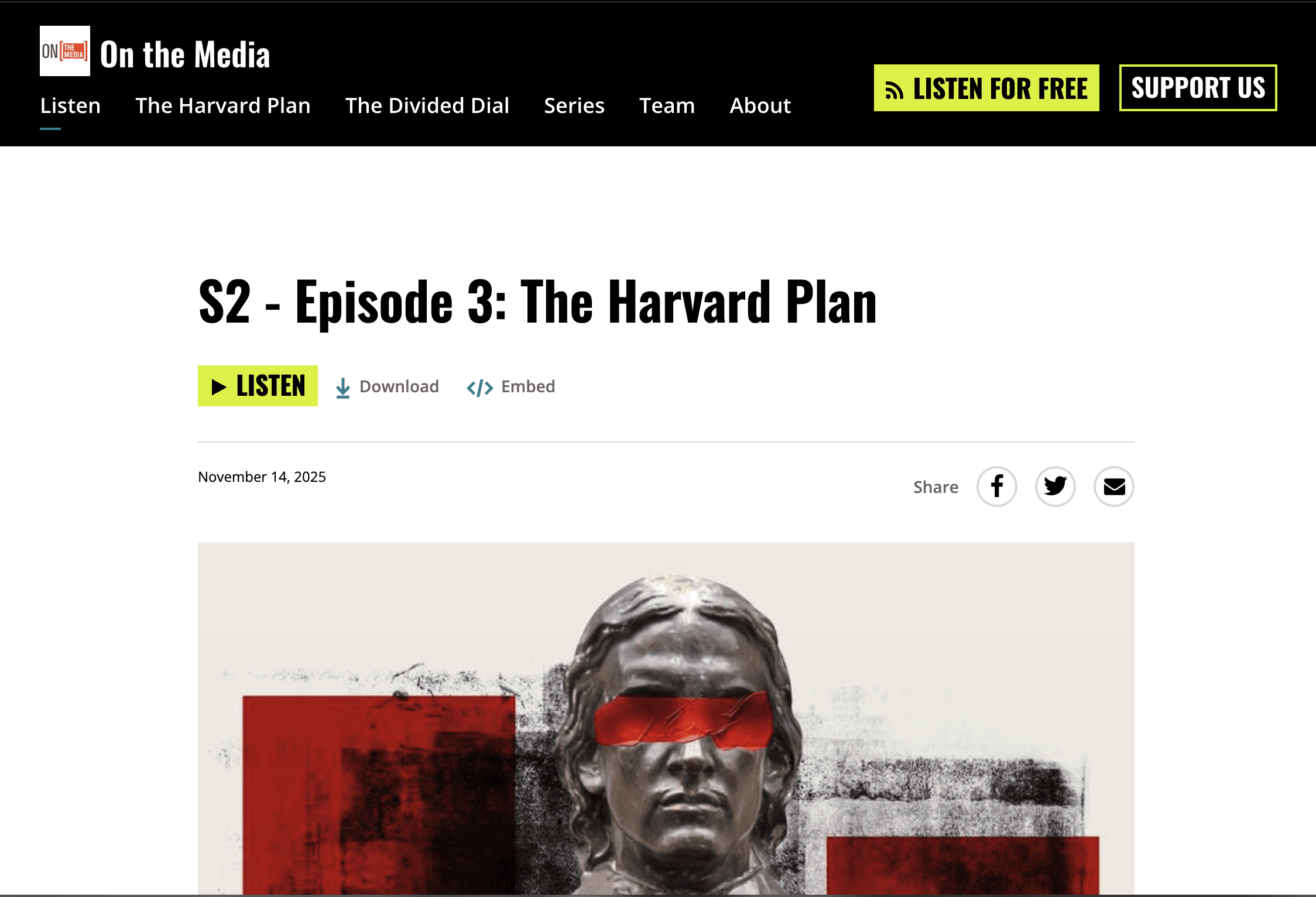
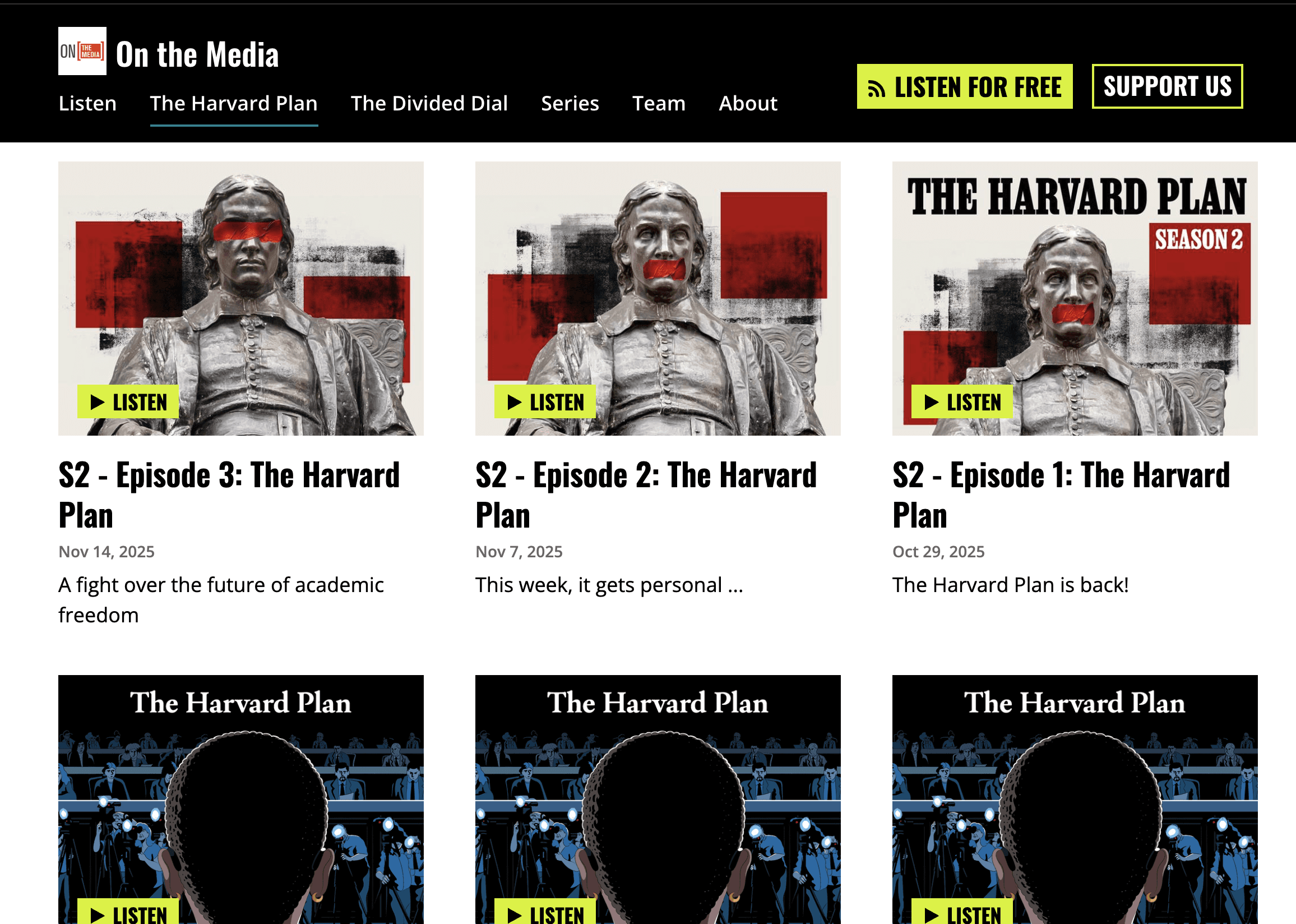
Series like The Harvard Plan and The Divided Dial need immediate context in the navigation and on landing pages so users understand what they are clicking into without extra friction.

Make podcast discovery easier with a dedicated site-wide search bar.

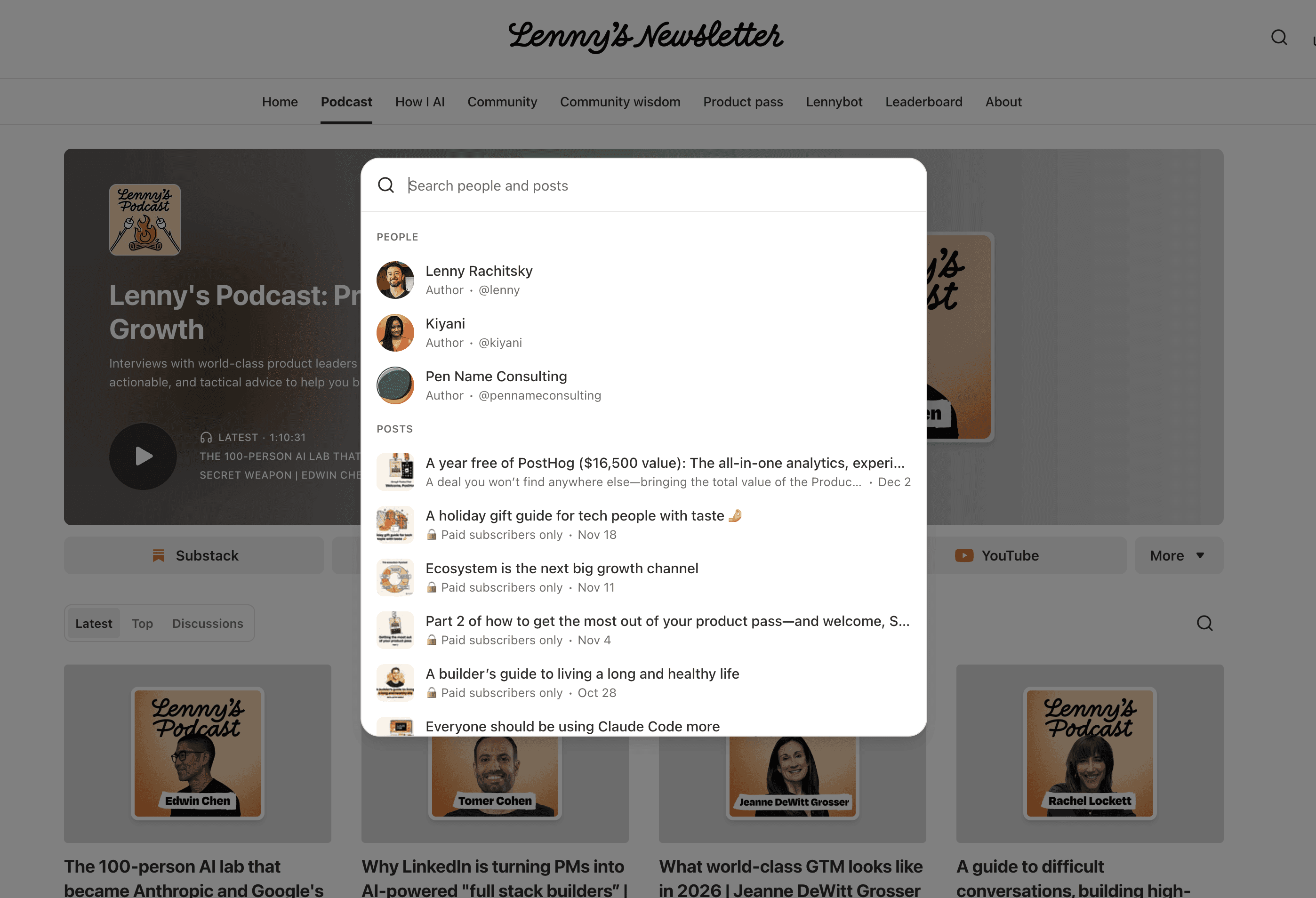
OTM’s catalog spans years of episodes and deep, complex topics. Adding a prominent search bar at the top of the site would let users quickly find episodes, themes, guests, or series without needing to manually browse through long lists.

Adding a search bar in this area would help users directly look up episodes, topics, or keywords, reducing friction for both new and returning listeners. Lenny's Podcast is a good example on the right.

Overall, there is a significant opportunity for OTM, NPR, and member stations to strengthen discovery, clarity, and long-term engagement across their digital ecosystem.

Conclusion

By refining how episodes are organized, improving context for complex series, and expanding content into more searchable, shareable formats, OTM can better meet audience expectations and reach new listeners where they already are.